Agentic AI in a small company: what I learned at 4YFN, MWC Barcelona
Agentic AI is AI that carries a task through from start to finish (it reads a document, checks it against your system, decides the next step and flags a person) instead of only answering when you ask it something. On 05/03/2026 I took part in a panel on this at the Spanish Chamber of Commerce stand inside 4YFN, the startup fair held alongside the Mobile World Congress in Barcelona, together with Pablo Soto, Director of AI and Innovation at Vodafone Business, moderated by Alexander Phimister. The practical takeaway for a small company is not “go build agents”: it is that small, local models are already good enough for most administrative work, that the real bottleneck is a badly built process rather than the technology, and that automating something properly means sticking around to maintain it.
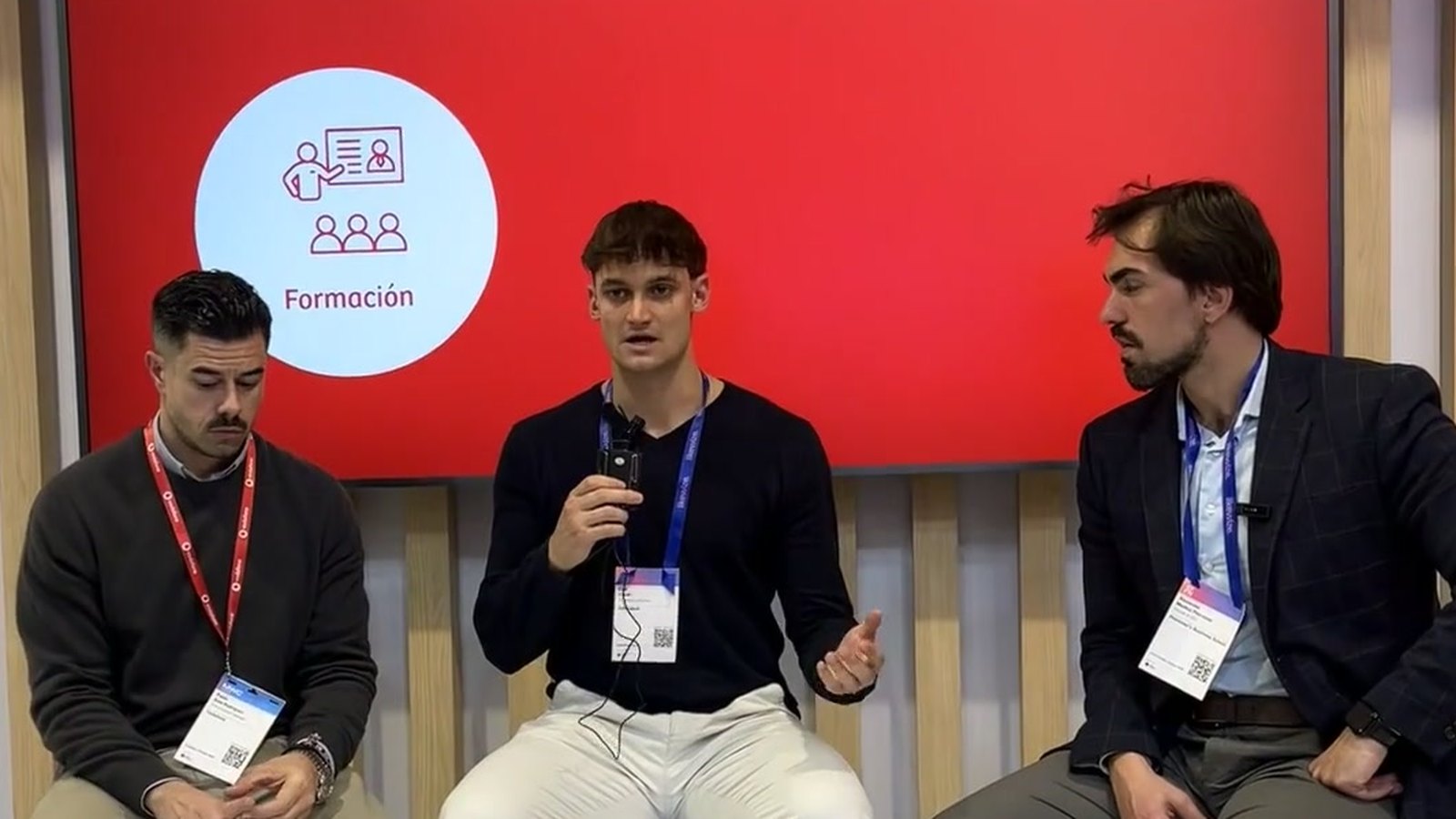
1. What that panel actually was (and what it was not)
Some context first, because this kind of thing gets inflated on LinkedIn and I would rather tell it straight. On 05/03/2026 the Spanish Chamber of Commerce ran two round tables at its stand inside 4YFN, the startup event held in parallel with the Mobile World Congress at Fira de Barcelona Gran Via. One was about funding. The other, the one I was on, was about how agentic AI is reshaping the future of startups and large corporations.
On the panel with me was Pablo Soto, Director of AI and Innovation at Vodafone Business, moderated by Alexander Phimister, founder and CEO of Phimister's Group. Forbes Spain covered it the following day in a piece on the conclusions from both round tables. It was not a keynote on the main 4YFN stage and it was not an award: it was a working panel at a stand, with a standing audience and no script. Which is, honestly, where the interesting things get said.
I mention it because the rest of this article is not about the anecdote. It is about the three or four ideas that came out of it, which I have spent six months watching play out in real companies, most of them small logistics, distribution and service firms that look nothing like a startup.
- Where: Spanish Chamber of Commerce stand, inside 4YFN (Fira Barcelona Gran Via), 05/03/2026.
- Who: Pablo Soto (Vodafone Business), Elek Cunill (DelegaloAI), moderated by Alexander Phimister.
- Topic: agentic AI applied to startups and corporations.
- Coverage: Forbes Spain, 06/03/2026.
2. What agentic AI is, and how it differs from a chatbot
The term is misused almost everywhere, so it is worth pinning down. A chatbot answers: you ask, it replies with text. Classic automation runs fixed rules: if an email arrives with this subject line, move this file to that folder. Agentic AI sits in between and does something different from both: it takes an objective, decides the steps, uses tools (your inbox, your ERP, your rate sheet, your CRM) and stops when it is done or when it needs a person.
The practical difference shows up with a delivery note. A chatbot would tell you which fields a delivery note contains. Classic automation will move the PDF into a folder if the subject line contains the word “delivery note”, and will break the day a supplier changes the wording. An agent reads the PDF however it arrives, pulls out the order number, looks it up in your system, spots that the delivered quantity does not match the ordered one, opens the incident with the fields already filled in and flags the right person. Nobody typed anything and nobody had to ask it anything.
That is the shift. It is not that the model got smarter, it is that it was given access to tools and permission to chain steps together. Which is why the conversation in 2026 is no longer about which model to use, but about what you give it access to and where you put the brakes.
- Chatbot: answers when asked. Zero access to your systems.
- Classic automation: runs fixed rules. Fast and cheap, breaks when the format changes.
- Agentic AI: takes an objective, uses your tools, chains steps and stops when it needs a person.
- What it is not: a system that decides anything with a cost attached on its own. Approving a payment, accepting a shortfall or closing a claim is still signed off by someone.
3. The shift from large models to small, local ones
The point from Pablo Soto that interested me most was the industry moving from large language models (LLM) towards small, local models (SLM), with control over data as the underlying reason. It is a shift that barely registers in the public conversation, because the headlines always go to the biggest model, but for a small company it is probably the most useful news of the last two years.
The reasoning is simple. Reading a delivery note, sorting an email, pulling the fields out of an invoice or drafting a reply are not tasks that need the most powerful model on earth. They are narrow, repetitive tasks with a recognisable shape. A small model handles them well, costs a fraction and, above all, can run on a server you control, without the document ever leaving your infrastructure.
That defuses the objection I hear most often in a first meeting: does this take my data away? With the right architecture, sensitive data does not travel. And where a large model genuinely helps (complex reasoning, long-form writing, open-ended analysis), it is sent only the minimum required, with no names or identifiers, which is the practice we apply by default.
| Large model in the cloud | Small local model | |
|---|---|---|
| Best suited to | Reasoning, writing, open-ended text analysis | Reading documents, classifying, extracting fields |
| Cost per task | High and variable | Low and predictable |
| Where the data lives | With the provider, unless you minimise it | On your server or your VPS |
| Speed | Depends on the provider's load | Constant, no queue |
| When we pick it | When the task is open-ended and the data is already anonymised | When the task is repetitive and the document is sensitive |
4. “Startups are no longer digital, they are AI native”: what that means if your company is 30 years old
On the panel we agreed that a company founded today is not merely born digital, it is born with automated processes and agents from day one, which lets it operate with smaller teams. It is a line that sounds good at a startup fair and that, said out loud in the warehouse of a 40-person logistics operator, can sound like an insult.
So let me translate it. If a new company in your sector can do what you do with half the back office, your advantage has to sit somewhere else: in your book of business, in how well you know your customers, in your supplier network. What it cannot be is three people typing data in, because that is pure cost and it is also exactly where someone will undercut you on price.
The conclusion is not be more like a startup. It is duller and more useful: get rid of the administrative work that does not differentiate you, and put those hours into the work that does. In an established company that is not done by switching systems, it is done by adding layers on top of the system you already have and that already works.
What an established company can copy
Document in and document out, which is where most administrative time disappears. Automated invoice reading with AI and matching against delivery notes is the highest-return case in any company handling more than a hundred documents a month.
First-line support. A good share of where is my order? answers itself if the system can see the real status, and that is the whole premise of the WhatsApp chatbot for companies: resolve what can be resolved and hand the rest to a person.
What it should not copy
Reckless speed. A startup can afford a week of something being broken because nobody depends on it yet. An operator running daily routes cannot. That is why in established companies we always build with human review at the points that carry a cost, and only remove it when several weeks of numbers say it is redundant.
And replacing judgement. AI proposes and prepares; who approves a credit note or accepts a rate exception is still a person with a name.
5. The real bottleneck is not the technology, it is the badly built process
What I said on the panel and still believe: many processes are badly structured. Automating them from scratch lets you skip unnecessary steps and gain competitiveness.
There is concrete experience behind that sentence. When you go in to automate something in a company, the temptation is to trace the process that already exists and bolt AI onto it. And the process that exists is almost never the process that is needed: it is the result of fifteen years of patches, of someone who left and whose method stayed, of one customer who once asked for something odd and turned it into the rule for everyone.
Automate that as-is and you automate the redundant steps too, and you end up with an expensive system doing badly the same thing that was already being done badly by hand. The real work is the uncomfortable half hour where you ask why is this step here? and half the time the answer is because it has always been done this way.
It is also why I distrust closed proposals written before anyone has looked. When someone quotes you an automation without having seen how you work, they are selling you their template, not your process. It is one of the warning signs we list in what an AI agency does and what it should not be selling you.
- Measure first: how many documents, how long a person takes, how many errors a month.
- Then prune: which steps exist purely out of inertia and can be removed before touching anything.
- Then automate: the clean version of the process, not the inherited one.
- And stay: when a supplier changes the delivery note format, someone has to fix it. That someone is the real work.
6. How all of this lands in a logistics operator
I come from event logistics, so the sector where I have seen this applied most is my own. And there agentic AI is not an experiment: it is reading delivery notes and proofs of delivery that arrive as phone photos, checking the carrier's invoice against the agreed rate, warning the customer about a delay before they call, and preparing the repetitive quote someone has been typing by hand for three years.
None of those four things requires changing the ERP or the CRM. They are built on top, reading and writing where you already work. It is exactly the premise of our AI for logistics page, and the process-by-process detail is in the seven processes in a logistics operator that are already being automated.
Where it does pay to slow down is on the sales side. Automating opportunity follow-up works, but only if the CRM reflects reality; if nobody updates it, AI does not fix the problem, it gets fixed beforehand. We go into that in sales automation on top of your CRM.
| What was said on the panel | What it means for your company | Where to start |
|---|---|---|
| Agentic AI chains steps on its own | You no longer need someone watching every task | The process with the most volume and the least judgement: document intake |
| The industry is moving to small, local models | Cost drops and sensitive data can stay in your house | Separating which tasks need a large model and which do not |
| New companies are born AI native | Your advantage cannot be administrative | Counting how many hours a month go into typing |
| Processes are badly structured | Automating the inherited process multiplies the error | Pruning steps before automating anything |
| Maintenance is the real work | A closed project with no maintenance degrades on its own | Agreeing who fixes it when a format changes |
7. What was not said on the panel (and should be said more)
Nobody talks about what does not work at a trade fair, so I will. First: the cost is not in building the automation, it is in maintaining it. An invoice reader that gets 97% right today will start failing the day a customer redesigns their PDF, and if nobody is watching you will find out from a mismatch three months later.
Second: some processes are not worth automating. If something happens five times a month, do it by hand. If every case is different and there is no pattern, same answer. And if your data is broken, the first thing you need is not AI, it is order. Saying this in a sales meeting costs money in the short term and saves it in the medium term.
Third: almost nobody asks where the document they upload ends up. It should be the first question, not the last. We answer it before it gets asked, which is why data minimisation leads every proposal that goes out of here.
And fourth, the most uncomfortable one: most companies do not need a transformation programme, they need one specific task taken off their hands and proof that it works before going further. Starting small is not a lack of ambition, it is the only way the second step gets taken on evidence rather than faith.
Frequently asked questions
What exactly is agentic AI?
It is an AI system that takes an objective and carries it out using real tools (email, ERP, CRM, files), chaining steps and stopping when it is finished or when it needs a human decision. It differs from a chatbot in that it does not wait to be asked, and from classic automation in that it does not depend on fixed rules that break when a format changes.
Do I need to change my ERP or CRM to use agentic AI?
No, and if someone tells you that you do, be suspicious. Automations are built on top of the system you already use, reading and writing where you already work. Replacing an ERP is a months-long project with operational risk; automating document intake takes weeks and interrupts nothing. You can see the approach in AI consulting in Barcelona.
Is it safe? Do my documents leave the company?
It depends on how it is built, and it is the right question to ask. Repetitive tasks (reading a delivery note, extracting invoice fields, sorting an email) are handled well by small models that can run on a server you control, without the document leaving. For anything that genuinely needs a large model, only the minimum is sent, with no identifiers. Insist on having that explained in writing before you sign.
How long before I see results?
In a narrow process with real volume (delivery notes, supplier invoices, customer follow-up) the first few weeks already give a reliable measure: how many documents go through on their own, how many go to review, and how much time has stopped being spent. If after four weeks there is no number to show, the project was badly framed.
What is an SLM and why does it matter to a small company?
An SLM is a small language model, trained or tuned for specific tasks rather than for everything. It matters because the administrative tasks in a small company are narrow and repetitive, exactly where a small model performs as well as a large one at a fraction of the cost, with the added advantage of running on your own infrastructure.
Where can I read the coverage of the event?
Forbes Spain published a piece on 06/03/2026 with the conclusions from both Chamber of Commerce round tables at 4YFN, including the agentic AI one. The official note from the Spanish Chamber of Commerce is published on its website. Both are linked in the sources for this article.
Sources
Which of your processes would survive this?
If you have read this far it is because there is a specific task someone on your team has been doing by hand for years. Tell us which one and we will tell you whether it is worth automating now, whether it should be tidied up first, or whether it is one of those best left alone. No templates and no hype. Start with AI for logistics from DelegaloAI or just write to us.
Free 30-minute assessmentKeep reading
AI agency and team
What an AI agency really does (and what it shouldn't sell you)
What an AI agency really does, which red flags to avoid (guaranteed ROI, all-in-one, zero maintenance) and when hiring one isn't worth it.
Sales and CRM
How to build a CRM that updates itself from your emails and WhatsApps
Build a CRM that updates itself by reading your emails and WhatsApps: conversation ingestion, a live profile per contact and a unified timeline, no typing required.